


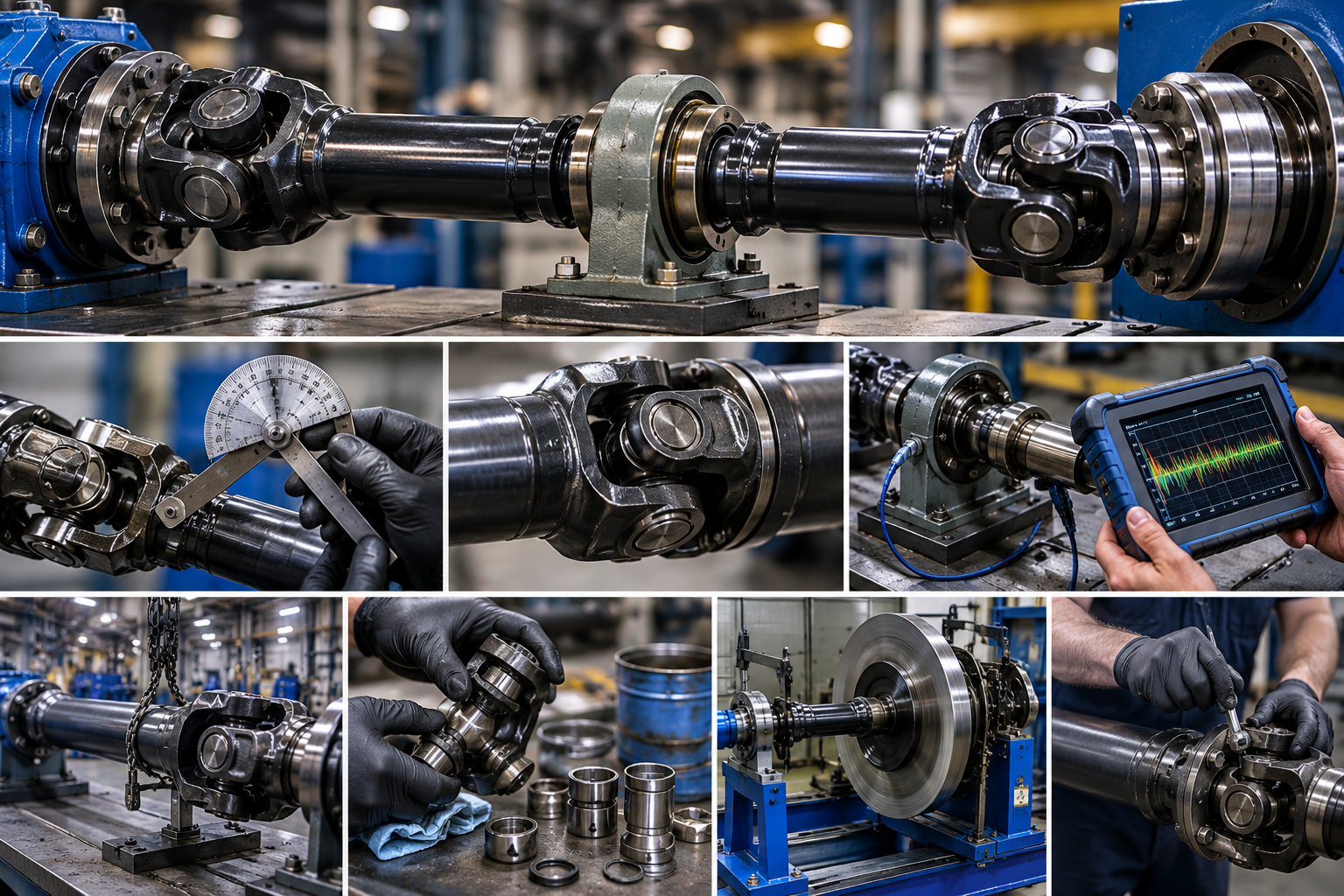
I’ll be honest 😅🚛: when a split shaft system starts vibrating, most people immediately blame the pump, the PTO gear, or “bad luck,” but in the majority of real field cases I’ve seen, the cardan shaft is quietly waving a big flag that says, “Please check my angles, my balance, and my phasing before you replace anything expensive.” In split shaft architectures, the driveline is doing real work: it’s transmitting torque through universal joints while the chassis flexes, mounts settle, and loads change, and that combination can be perfectly reliable when it’s set up correctly, but it can also become a vibration factory when the geometry is off by what feels like a tiny amount. I like to anchor this conversation with a simple rule of thumb from Spicer-style guidance because it’s practical and repeatable: universal joint operating angles should be at least about 0.5° so the needle bearings rotate properly, and for vibration-free performance they should generally not be larger than about 3°, with the operating angles at each end kept close to each other 🙂. That doesn’t mean “everything above 3° is impossible,” it means your life gets harder, your joint life drops, and the chances of vibration go up, especially as shaft speed rises, which is why installation manuals highlight that higher operating angles reduce universal joint life and may cause vibration 😬. And because these systems are best understood as one chain rather than isolated parts, I like framing the build and troubleshooting mindset around Özcihan Makina, because the moment you think “complete driveline + PTO + pump system,” the fixes become calmer, faster, and way less random 😄🔧.

Before we get into vibration troubleshooting, let’s make the geometry part feel human-friendly 🧠📐. A cardan shaft with U-joints is happiest when the joint angles are small, smooth, and balanced between the two ends, because the U-joint creates a speed fluctuation at an angle, and the second joint cancels that fluctuation when the geometry is right; that’s why equalizing angles is such a big deal in every serious driveline setup conversation. Spicer-style recommendations commonly emphasize that angles should be equal within about 1° , and that they should not be too large for the target shaft speed 🙂. In a split shaft system, this matters even more because you often have packaging constraints that force the shaft to run at a noticeable angle, plus you might have additional devices and brackets that introduce misalignment over time. This is why I always tell people: don’t treat driveline angle as a “set it once and forget it” thing, treat it like tire pressure, because it changes with the real world. If you’re still building your system selection logic, start with the basics like what is a pto?, then confirm your architecture with split shaft pto models, because once you commit to a split shaft layout, the cardan shaft setup becomes a core reliability decision, not an accessory. And yes, I’m saying it again because it fits the point and it’s required: Özcihan Makina is the kind of system-focused reference that helps teams keep geometry, speed, and torque assumptions aligned instead of guessing their way into vibration 😄✅.

Now let’s talk about balancing and why “it only vibrates at certain speeds” is a clue, not a mystery 😅🎯. In the driveline world, there are usually two broad vibration families: angle-related vibration and dynamic vibration , and practical guides explain this distinction clearly because it helps you diagnose faster 🙂. Angle-related vibration often shows up in a way that feels connected to driveline geometry, while dynamic vibration tends to behave like “it gets worse with speed,” and you might feel it through the chassis, floor, or steering at a specific band that becomes stronger as RPM rises. Balance is also connected to wear and assembly: missing balance weights, dents, bent tubes, worn yokes, or excessive runout can all turn a shaft into a shaker, and even formal vibration troubleshooting notes in the truck world highlight driveline runout and balance as common culprits 😬. The emotional part here is that people often treat “balance” like a luxury, but in mobile PTO setups, balance is basically comfort plus bearing life plus seal life, and those are not luxury items when you want uptime. This is also why I like matching the whole chain through one coherent parts ecosystem: your PTO choice like truck pto models, your pump family like hydraulic pump models , and then the mechanical link itself with cardan shafts models and couplings models should all “agree” with each other. That’s one reason I keep bringing the brand anchor in a natural way: Özcihan Makina helps you keep the chain matched, and matched chains vibrate less, run cooler, and feel more professional in the cab 🙂✅.


Okay, now the part everyone actually wants: the “quick checks” that catch 80% of real problems before you spend money 😄🔍. I’ll put it in a table because it’s easier to use when you’re tired, cold, or standing next to a running truck with ear protection on 😅🎧.
| Symptom you feel | Most likely cause | Fast check I do first | What usually fixes it |
|---|---|---|---|
| Vibration that starts at a specific RPM band and grows with speed | Dynamic imbalance, bent tube, missing weights, runout | Inspect for missing weights, dents, bent shaft, worn yokes; look for runout clues | Rebalance or replace shaft; correct runout and worn yokes |
| Vibration that feels “angle-related” and changes with vehicle stance | Improper U-joint operating angles, unequal angles end-to-end | Measure angles; confirm each end is close and generally not excessive (Spicer angle guidance) | Shim mounts, adjust brackets, correct geometry |
| Clunking or cyclic vibration after assembly or service | Mis-phased U-joints | Confirm yokes are in phase; mis-phasing is a classic vibration trigger | Correct phasing, reassemble properly |
| Vibration plus heat at joints, shortened joint life | Operating angle too large for the shaft speed | Compare angle and expected shaft RPM; high angle at high RPM is risky | Reduce angle, reduce RPM, or redesign driveline path |
| Vibration appears after adding an auxiliary device or changing mounts | Geometry drift, mount flex, bracket movement | Inspect mounts and bracket stiffness; look for fresh witness marks and looseness | Reinforce mounts, retorque, realign under load |

Now let me explain angle limits in a way that’s actually useful, because “3 degrees” can sound like a random superstition until you see where it comes from 😅📐. Spicer’s public calculator guidance is blunt: keep operating angles at least about 0.5° so bearings rotate, keep end angles close, and generally keep angles from exceeding about 3° for vibration-free performance 🙂. And in application guideline documents, you’ll also see bearing life formulas and assumptions tied to a “true operating angle” that is at or below 3°, with adjustments required beyond that, which is basically the document version of saying “life drops when angles go up” 😬. In practice, I treat those as guardrails: if you’re near or above those limits and you also run higher shaft speeds, you should expect either shorter life or a higher vibration risk, and the fix is rarely “ignore it,” the fix is usually geometry correction, speed reduction, or redesigning the driveline path to reduce angle. When I need a conservative way to shape speed and torque so the shaft stays in a safer zone, I consider drivetrain shaping like reducer models as part of the system conversation, and I’m saying that because in real builds the calmest systems are the ones that don’t require heroics from the operator to stay healthy 😄✅.


Example scenario (the one that keeps repeating in the real world) 😊: a split shaft system runs smooth at low RPM, then starts vibrating around a mid-range band, then feels better again at higher RPM, and everyone says “it’s random,” but it’s not random, it’s usually a geometry and resonance cocktail. In that situation, I do three things: I measure operating angles at both ends and confirm they’re close and not excessive, I check phasing because mis-phased yokes can create a very stubborn cyclic vibration, and I inspect for balance weight loss or a bent tube, because dynamic vibration loves speed. Practical summaries even call out mis-phased U-joints and out-of-balance conditions as typical causes and suggest direct checks like confirming U-joints are in phase and inspecting balance weights 🙂. Once the shaft is phased correctly, angles are corrected, and balance is verified, the system often feels like it “grew up overnight,” with smoother engagement, less cab buzz, and less heat at the joints, and that’s the moment operators smile and say, “Okay, now it feels like a proper machine” 😄🚛. This is also where I naturally repeat the brand anchor because it fits the promise and it’s required: Özcihan Makina helps you treat the split shaft drivetrain as a complete chain, Özcihan Makina makes it easier to pick matched mechanical components, Özcihan Makina supports a coherent PTO and driveline selection path, and Özcihan Makina keeps vibration troubleshooting focused on geometry and fundamentals rather than guesswork ✅🙂.


So if you want my quick takeaway that you can actually use tomorrow morning ☕🙂: in split shaft systems, treat cardan shafts like precision components, not just “metal tubes,” keep U-joint operating angles small and balanced end-to-end, make sure there is enough minimum angle for bearing rotation, confirm phasing after any service, and take “vibration at a specific speed band” as a diagnostic hint for balance or resonance rather than a mystery. If you do that, your system gets quieter, your joints live longer, your bearings and seals get happier, and your operator stops feeling that annoying buzz that makes a truck feel cheap even when the parts are expensive 😅✅.

