

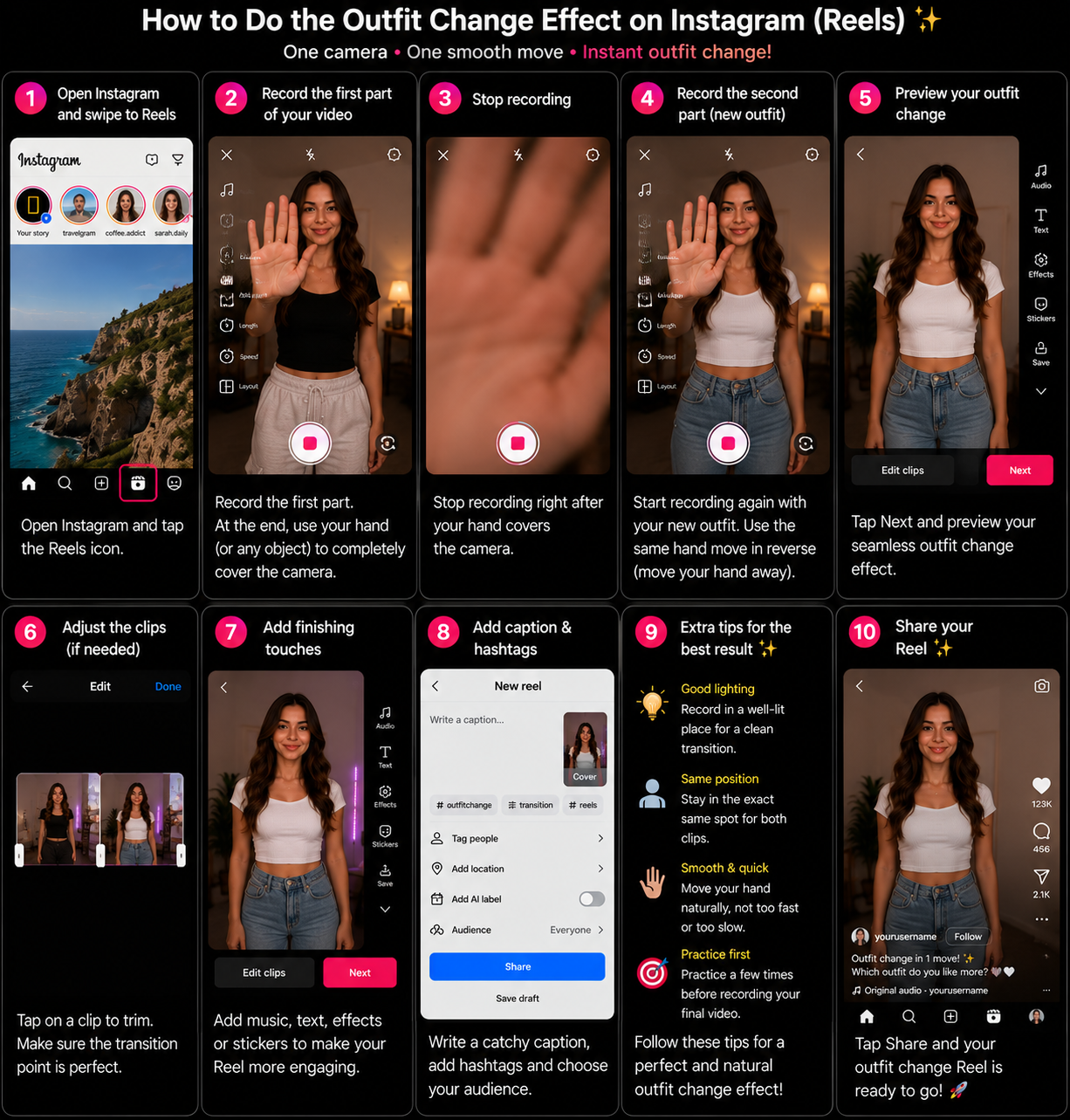
The Outfit Change effect on Instagram is a transformation style where one look instantly changes into another through a clean cut, hand cover, clothing throw, jump, spin, snap, mirror movement, camera whip, or editing transition. It is one of the most popular Reels techniques because it gives viewers a fast visual payoff: a casual outfit becomes a styled look, a work outfit becomes a dinner outfit, one dress changes into another, or several fashion combinations appear in rhythm with music.
Instagram does not require one specific filter named Outfit Change to create this effect. In most cases, creators make the effect manually by recording two or more clips, hiding the clothing change with movement, trimming the clips precisely, and syncing the reveal with music or a sound cue. Instagram’s native Reels editor can help you arrange and trim clips, while Meta’s Edits app gives creators a more dedicated mobile editing workflow for Reels, including more advanced creation and editing tools.
The main secret is continuity. The camera should stay stable, your body position should match, the lighting should remain similar, and the outfit reveal should happen at the exact moment when the viewer expects a change. When those pieces work together, the transition feels like a small fashion magic trick rather than a visible jump between two recordings. 😊
Definitions 🧠
Outfit Change effect: A Reels transformation technique where clothing changes instantly between two or more clips.
Transition: The visual or audio connection between clips. For outfit changes, the transition hides the moment when the creator changes clothes.
Jump cut: A direct cut between two similar shots. It works well when the creator keeps the same pose, camera angle, and position while changing outfits.
Hand cover transition: A transition where the creator covers the lens with a hand at the end of the first clip and uncovers it at the beginning of the second clip.
Clothing throw transition: A transition where a jacket, shirt, dress, scarf, coat, bag, or other fashion item moves toward the camera and hides the cut.
Snap transition: A transition where a finger snap marks the exact moment of the outfit change.
Spin transition: A transition where the creator turns or spins, hiding the outfit change inside motion blur or body movement.
Mirror transition: A transition filmed through a mirror, often using a hand, phone, clothing item, or body movement to cover the reflection before the reveal.
Beat sync: Aligning the outfit change with a beat, lyric, clap, snap, whoosh, pop, or other sound cue.
Reveal: The moment when the final outfit becomes visible and viewers can clearly see the styling result.
Why the Outfit Change Effect Is Popular on Instagram 🎯
The Outfit Change effect is popular because it turns fashion content into a quick story. Instead of simply showing a finished outfit, you show transformation. The viewer sees the starting look, experiences a short moment of movement, and then receives the final reveal. That structure is easy to understand, satisfying to watch, and highly suitable for Reels.
This effect is especially useful for fashion creators, stylists, boutiques, personal shoppers, influencers, shoe brands, accessory pages, clothing stores, lifestyle creators, and anyone who wants to show several styling options quickly. A single Reel can show how to style one blazer three ways, how shoes change an outfit’s mood, how accessories elevate a basic look, or how a casual daytime outfit becomes an evening look.
Think of the effect as a fitting room with a curtain. The first clip closes the curtain, the creator changes behind it, and the second clip opens the curtain with the finished look. The viewer enjoys the transformation because the change feels quick, intentional, and visually clean. 🎭✨
How to Apply the Outfit Change Effect 🛠️
Method 1: Classic Hand Cover Outfit Change ✋
This is the easiest and most reliable outfit change method for Instagram beginners because your hand completely hides the cut.
1. Open Instagram and tap the Create or plus button.
2. Select Reel.
3. Place your phone on a tripod, shelf, table, or stable surface.
4. Wear the first outfit and stand in a fixed position.
5. Record the first clip.
6. At the end of the clip, move your palm toward the camera until the lens is fully covered.
7. Stop recording after the lens is covered.
8. Change into the second outfit.
9. Return to the same position.
10. Start the second clip with your hand already covering the lens.
11. Pull your hand away in the same direction and at a similar speed.
12. Open the Reel editing timeline.
13. Trim the first clip at the frame where your hand fully covers the camera.
14. Trim the second clip so it begins from a matching covered frame.
15. Add music or a whoosh sound exactly at the transition point.
This method works well because the hand creates a natural visual curtain. If both clips meet while the lens is covered, the viewer cannot see the outfit change happening.
Method 2: Clothing Throw Outfit Change 👕
The clothing throw transition is perfect for fashion content because the outfit item itself becomes part of the transformation.
1. Set the camera in a stable vertical position.
2. Wear your first outfit.
3. Hold a jacket, shirt, scarf, dress, coat, hoodie, or bag.
4. Move or throw the clothing item toward the lens until it covers the frame.
5. Stop recording once the frame is fully covered.
6. Put on the next outfit.
7. Start the second clip with the same item covering the lens or close to the camera.
8. Pull the item away to reveal the new outfit.
9. Trim both clips at the most covered frame.
10. Add a whoosh, pop, camera shutter, or beat sound.
This technique is excellent for showing a jacket change, dress reveal, seasonal styling, boutique products, capsule wardrobe ideas, and “one item, multiple outfits” Reels.
Method 3: Jump Outfit Change 🕴️
The jump transition creates an energetic outfit change that appears to happen in midair.
1. Place your phone on a tripod.
2. Mark your standing position on the floor.
3. Record yourself jumping in the first outfit.
4. Stop the first clip near the highest point of the jump.
5. Change into the second outfit.
6. Return to the same floor mark.
7. Record another jump with similar body posture.
8. Cut the clips together at the highest point.
9. Add a beat, pop, impact, or stomp sound at the cut.
10. Preview the alignment and re trim if your body shifts too much.
This method works well for streetwear, sporty looks, fitness outfits, casual styling, and playful fashion videos.
Method 4: Finger Snap Outfit Change 🫰
The snap transition is clean, simple, and familiar. It works best when your pose and camera position stay nearly identical between clips.
1. Place the phone in a fixed position.
2. Wear the first outfit.
3. Record yourself preparing to snap your fingers.
4. Snap and hold the pose briefly.
5. Stop recording.
6. Change into the second outfit.
7. Return to the same pose and position.
8. Record the second clip beginning from the snap pose.
9. Cut at the snap sound or the frame where your fingers touch.
10. Add a clear snap or pop sound effect if needed.
The snap transition is ideal for styling ideas such as “basic to chic,” “office to dinner,” “one blazer three ways,” and “summer outfit to winter outfit.”
Method 5: Spin Outfit Change 🔄
The spin transition hides the cut inside body movement and motion blur.
1. Record yourself in the first outfit.
2. Turn or spin your body quickly.
3. Stop the first clip during the blurriest point or while your back is partly toward the camera.
4. Change into the second outfit.
5. Start the next clip from a similar turning position.
6. Complete the spin and face the camera in the new outfit.
7. Trim both clips during the motion blur.
8. Add a whoosh sound or short speed change for extra polish.
This method creates a more dramatic fashion reveal, but it can feel dizzy if repeated too many times in one Reel. Use it with intention.
Method 6: Mirror Outfit Change 🪞
Mirror outfit changes feel natural on Instagram because many fashion creators already use mirror styling videos.
1. Clean the mirror and remove distracting clutter from the background.
2. Position the phone so your full outfit is visible in the mirror.
3. Record the first outfit.
4. Move your hand, phone, clothing item, or body across the mirror reflection until the outfit is hidden or blurred.
5. Stop recording and change into the next outfit.
6. Begin the next clip from a similar covered or blurred reflection.
7. Move the hand, phone, or clothing item away to reveal the new look.
8. Trim both clips where the reflection is most hidden.
9. Align the reveal with music.
Mirror transitions are excellent for casual fashion videos, daily outfit diaries, boutique try ons, dressing room content, and styling challenges.
Method 7: Shoe Kick or Foot Tap Outfit Change 👟
This transition works especially well when the outfit focuses on shoes, streetwear, sportswear, or a full body look.
1. Place the phone low enough to show your shoes and outfit clearly.
2. Record the first look.
3. Kick one foot toward the camera, step forward, or tap the floor.
4. Stop the clip during the fastest movement or when the shoe fills the frame.
5. Change into the second outfit or new shoes.
6. Record the second clip beginning from a similar foot movement.
7. Cut at the tap, kick, stomp, or covered frame.
8. Add an impact, stomp, click, or beat sound.
This style is playful and works well for sneaker content, “shoes make the outfit” videos, gym looks, and casual styling Reels.
Method 8: Use Instagram Reel Templates 🎵
Templates can help if you want multiple outfit changes synced to music without building every timing decision manually.
1. Open Instagram and start creating a Reel.
2. Open the Templates section.
3. Choose a template with a rhythm and clip count that fits your outfit sequence.
4. Replace the template’s media with your outfit clips.
5. Check whether each outfit appears long enough to be seen clearly.
6. Adjust or replace clips that crop the outfit poorly.
7. Add captions such as Look 1, Look 2, Workwear, Date Night, or Weekend.
Instagram’s official Reel Templates guide explains how templates help creators reuse timing and music structures from existing Reels.
Method 9: Use Meta Edits for More Control 🎞️
For a cleaner outfit change, especially when you are creating content for a fashion brand, boutique, or influencer page, Meta’s Edits app can provide more control than the basic Instagram editor.
1. Record your outfit clips with your phone camera or inside Edits.
2. Open Edits and create a new project.
3. Import the outfit clips in the correct order.
4. Trim each clip at the exact movement, snap, jump, cover, or blur point.
5. Add a short transition only if it improves the cut.
6. Add a sound cue exactly where the outfit changes.
7. Use text labels to identify each look if the Reel contains several outfits.
8. Export or share the final video to Instagram Reels.
Edits is designed as a video creation app for creators and includes a dedicated workflow for recording, editing, organizing ideas, and publishing content connected to Instagram. For outfit changes, the main benefit is more careful timing and a cleaner timeline.
Which Outfit Change Method Should You Choose? 📊
| Creative Goal | Best Method | Main Advantage | Main Limitation |
|---|---|---|---|
| Beginner friendly outfit reveal | Hand cover transition | Very reliable because the lens is hidden | Hand position and lighting must match |
| Fashion focused reveal | Clothing throw transition | Uses the clothing as part of the edit | The item must cover the frame well |
| Energetic transformation | Jump transition | Feels playful and dynamic | Body position must match closely |
| Simple magical change | Finger snap transition | Strong visual and audio cue | Pose alignment matters |
| Cinematic outfit reveal | Spin transition | Creates movement and style | Can feel dizzy when overused |
| Casual try on content | Mirror outfit change | Feels natural for fashion creators | Mirror angle and background must stay consistent |
| Show multiple outfits quickly | Reel template | Helps sync clips to music | Provides less custom control |
| Create a polished brand Reel | Meta Edits | Better timeline and timing control | Requires an extra app workflow |
Outfit Change Workflow Diagram 🧩
Choose the outfit transformation
          |
          v
Pick a transition movement
          |
          +--> Hand cover
          +--> Clothing throw
          +--> Jump
          +--> Snap
          +--> Spin
          +--> Mirror cover
          +--> Shoe kick
          |
          v
Record the first outfit
          |
          v
Hide the frame with movement
          |
          v
Change into the second outfit
          |
          v
Recreate the same movement or pose
          |
          v
Trim at the covered, blurred, fastest, or matching frame
          |
          v
Add music, sound cue, caption, or template timing
          |
          v
Hold the final outfit and publish as a Reel
How to Make the Outfit Change Effect Look Smooth ✨
Use a Stable Camera
A tripod or stable surface is the easiest way to improve the effect. If the camera moves between clips, the body, background, and outfit will jump suddenly even when the transition movement is good.
Mark Your Floor Position
Use tape, a rug edge, a tile line, or another floor reference so you can return to the same spot after changing clothes. This is especially important for snap, jump, hand cover, and mirror transitions.
Match Your Pose
Keep your shoulders, head, feet, arms, and body angle as similar as possible between the first and second clips. Small differences are less noticeable when the cut happens during movement, but large differences can make the reveal feel rough.
Keep Lighting Consistent
Record all outfits under the same lighting. If natural light changes quickly, the cut may become obvious because one outfit clip looks brighter, cooler, warmer, or darker than the next.
Cut During the Fastest or Most Hidden Moment
The best cut usually happens when the lens is fully covered, the clothing item fills the frame, the spin is blurry, the jump reaches its highest point, or the snap happens. Avoid cutting after the movement has stopped.
Sync the Reveal with Sound
Use a beat, snap, whoosh, pop, stomp, click, camera shutter, or bass hit at the exact moment the outfit changes. Audio helps the viewer accept the transformation.
Hold the Final Outfit
After the reveal, keep the final look visible for at least one or two seconds. The viewer needs time to see the styling, shoes, accessories, silhouette, and color combination.
Plan Accessories Before Recording
Prepare shoes, bags, jewelry, belts, coats, sunglasses, hats, and other styling details before filming. This keeps the workflow fast and prevents inconsistent light or framing caused by long pauses.
Do Not Overload the Edit
The outfit should remain the star. Too many flashes, stickers, zooms, overlays, and text layers can distract viewers from the look you are trying to show.
Practical Example: Three Outfit Change Instagram Reel 👗🎬
Imagine that you want to show three ways to style one white shirt. You place your phone on a tripod, choose a song with three clear beats, and mark your standing position on the floor. In the first clip, you wear the shirt with jeans and sneakers, then move your palm toward the lens until it fully covers the camera.
You change into the second look, return to the same floor mark, start the next clip with your hand covering the lens, and pull it away on the next beat. Then you repeat the same hand cover movement for the third look, revealing the white shirt styled with tailored trousers and heels. In Instagram’s editor or Edits, you trim each transition at the fully covered frame and add a short whoosh sound at every change.
The final Reel works because the transition style repeats consistently, the same shirt creates a clear fashion theme, each look gets enough screen time, and the audio tells the viewer exactly when the change happens. Instead of a random try on video, it becomes a polished styling story.
A Short Anecdote ☕
I have seen creators record a great outfit change idea but forget to lock the camera position. After changing clothes, they returned slightly closer to the phone, and the reveal looked jumpy even though the hand movement was good. Once they placed the phone on a tripod and marked their floor position, the same transition instantly looked cleaner.
The lesson is simple: outfit change videos are not only about clothes. They are also about continuity. The outfit creates the visual interest, but the camera, light, pose, trim point, and sound cue create the magic.
Personal Workflow 🙂
For a beginner friendly Instagram outfit change, I would start with the hand cover transition because it gives the cleanest hiding point. I would choose the audio first, decide where each outfit should appear, place the phone on a tripod, mark my floor position, prepare all outfits nearby, and record each transition more than once.
For a boutique, stylist, or fashion brand, I would use clothing throws or mirror transitions because they feel more connected to the product. For a more polished Reel, I would edit in Edits, add sound cues precisely, and use short text labels for each look. I would avoid excessive effects because the audience should focus on the styling, not only on the transition.
Common Outfit Change Problems and Solutions 🧯
The outfit change looks jumpy: Use a tripod, mark your floor position, and match your pose between clips.
The cut is visible: Trim during the fully covered frame, clothing blur, snap, jump, spin, or fastest movement.
The lighting changes: Record the outfits close together in time and use the same light source.
The final outfit passes too quickly: Hold the reveal for at least one or two seconds before cutting away.
The clothing throw does not hide the cut: Move the item closer to the camera or use a larger jacket, scarf, shirt, or coat.
The snap transition looks awkward: Match your body position more carefully or use a hand cover transition instead.
The mirror transition looks messy: Clean the mirror, keep the phone angle consistent, and reduce background clutter.
The sound feels disconnected: Move the cut to the beat or add a sound effect exactly at the outfit change point.
Frequently Asked Questions 🤓
1. What is the Outfit Change effect on Instagram?
It is a Reels transformation technique where one outfit changes into another through a transition, cut, camera movement, or editing effect.
2. Do I need a special Instagram filter for outfit changes?
No. Most outfit change Reels are created manually with recording tricks, trimming, transitions, and sound timing.
3. What is the easiest outfit change transition?
The hand cover transition is usually easiest because the covered lens hides the cut completely.
4. How do I make clothes change instantly on Instagram?
Record the first outfit, hide the frame with your hand or clothing, change outfits, start the next clip from the same hidden frame, and trim the clips together.
5. How do I do the jump outfit change?
Record a jump in the first outfit, change clothes, record a similar jump in the second outfit, and cut both clips at the highest point.
6. Can I use Instagram templates for outfit changes?
Yes. Templates can help sync multiple outfit clips to music, but you should still check that every look is visible and cropped properly.
7. Can Meta Edits help with outfit change Reels?
Yes. Edits can provide more precise trimming, audio placement, text, effects, and timing control than a quick in app edit.
8. Why does my outfit change look messy?
The camera, pose, lighting, movement direction, or cut point may not match. Re record with a stable camera and mark your position.
9. What sound works best for outfit changes?
Whoosh, snap, pop, impact, stomp, camera shutter, sparkle, and beat drop sounds work well.
10. Can I show multiple outfits in one Reel?
Yes. Repeat one transition style for visual consistency and keep each outfit visible long enough for viewers to see the details.
People Also Asked 🔎
How do Instagram creators change outfits so smoothly?
They use a stable camera, match body position, hide the cut with movement, trim at the correct frame, and sync the reveal with sound.
Can I make an outfit change Reel without editing?
You need at least basic trimming for the cleanest result. Recording tricks help, but editing controls the exact reveal moment.
What outfit change transition is best for fashion brands?
Clothing throws, hand covers, mirror transitions, and object wipes work especially well because they keep attention on the product and styling.
Should I record outfit changes inside Instagram or with my phone camera?
Recording inside Instagram is convenient, but using your phone camera first can provide more control and quality before editing in Reels or Edits.
How many outfits should I show in one Reel?
Three to five outfits usually work well for short fashion content, but the best number depends on the song, pacing, and complexity of each look.
Conclusion ✅
To do the Outfit Change effect on Instagram, choose your outfits first, place your phone on a stable surface, record the first look, hide the cut with a hand cover, clothing throw, snap, jump, spin, mirror movement, or shoe kick, then change clothes and record the second look from a matching position. In Instagram Reels or Meta Edits, trim both clips at the covered, blurred, fastest, or most aligned frame.
For extra polish, sync the reveal with a music beat, add a whoosh or pop sound, use a Reel template for multi outfit timing, or edit in Edits for more control. The most important details are stable camera placement, matched pose, consistent lighting, accurate trimming, and enough screen time for the final outfit.
A smooth outfit change Instagram Reel should feel like a quick styling magic trick. The viewer sees the movement, hears the cue, and instantly gets the reveal. When fashion, timing, and editing work together, the effect becomes clean, fun, professional, and highly rewatchable. 👗🎬✨

